

Explore Listing
The Armed Forces Act 2006 received Royal Assent on 8 November 2006. Section 359 of the Act recognised that those executed for military disciplinary offences during the period 4 August 1914 to 11 November 1918 were in fact victims of the First World War and were therefore granted a posthumous pardon. Such disciplinary offences included:
Casting away arms
Cowardice
Sentry sleeping at or quitting his post
Mutiny and sedition
Striking etc a superior officer
Disobedience in defiance of authority
Desertion or attempt etc to desert
 The Second Siege of Badajoz during the Peninsular War marked the beginning of the Young Inniskillings' (3rd Battalion) war service.
The siege lasted from 13 October 1899 to 17 May 1900, a total of 217 days. Mafeking was surrounded by General Piet Cronje's Boer force of some 5,000. The 2,000 strong British garrison was commanded by Colonel Robert Baden-Powell. There were also 7,500 Africans, many displaced from the surrounding areas.
The Entente Cordiale was signed on 8 April 1904 between the United Kingdom and France and began the alliance against Germany and Austria-Hungary. The signing of the Entente Cordiale brought to an end centuries of conflict between the British and French. The Entente Cordiale, along with the Anglo-Russian Entente and the Franco-Russian Alliance, became part of the Triple Entente of Britain, France, and Russia who were the Allies that would fight the German and Austro-Hungarian Empires in the First World War.
A constant need of trench warfare in the First World War was to know what your enemy was doing. On the Western Front the British organised regular raids of the German trenches to find out information such as what and how many troops were in the area and what weapons they had. Most of these raids happened at night and as silently as possible. This lead filled truncheon, made even more lethal by the addition of steel boot studs, was used in the hand to hand fighting that happened in the narrow confines of the trenches.
Detail from the lid of a large silver cup 'presented to 1st Inniskillings by the European residents in Tientsin, China for their good service during the disturbances 1909 – 1912'.
In 1909 various European Powers extended their garrisons in Northern China to protect their political and commercial interests in the Celestial Empire. A detachment was sent to guard the British Legation in Peking (Beijing). The Inniskillings were due to leave China in October 1911 but were suddenly recalled after mutinous Chinese soldiers caused serious trouble in Peking and Tienstin.
This item was presented to the Officers of 27th Inniskillings by Lieutenant Colonel AI Hancocks as a memento of his command of the Battalion in China 1911 – 1912.
There are further markings on the base which are difficult to read but suggest that the original value might have been $50.83 when purchased or commissioned in Tientsin in January 1912.
The shape is thought to resemble that of a Chinese shoe.
One of a set of 6 silver goblets bearing the raised crest of the Fermanagh Militia, formerly the 71st Fermanagh Light Infantry, which later became 4th Battalion Royal Inniskilling Fusiliers. The Regimental motto was “Ut Proavi” and is shown on the crest along with 71 below the castle.
Detail of a silver Royal Irish Regiment cap badge sculpture. The piece of silver, which is now displayed in Regimental Headquarters, would in the past have adorned the dining table of the Officers’ or Warrant Officers’ and Sergeants Mess.
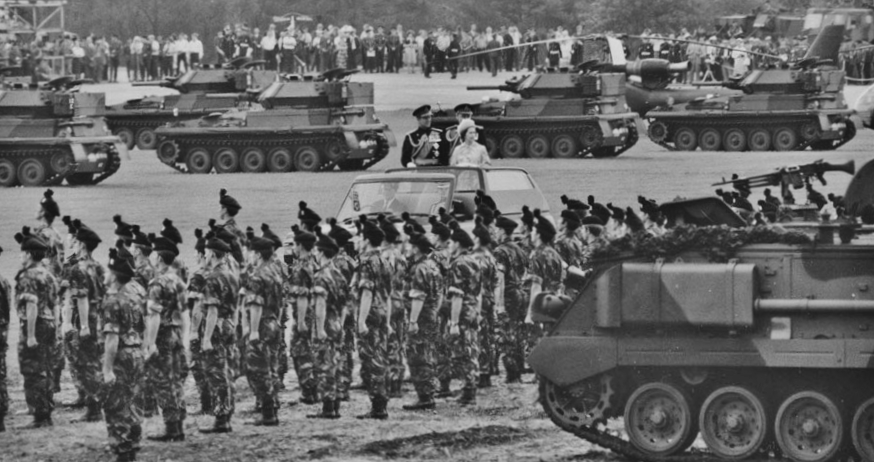
Her Majesty Queen Elizabeth II, accompanied by HRH The Duke of Edinburgh, was escorted by the Chief of the General Staff, General Sir Roland Gibbs, as she conducted the review of the British Army as represented by those on parade at Sennelager on 7 July 1977.
The 2nd Battalion The Royal Irish Rangers was on parade and later that year, twenty-one members of the Battalion received the Silver Jubilee Medal.